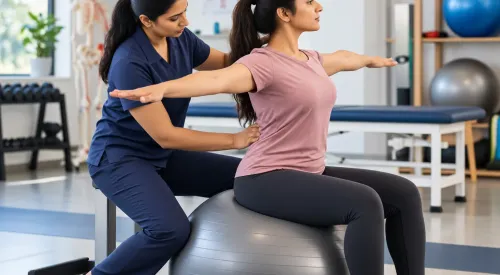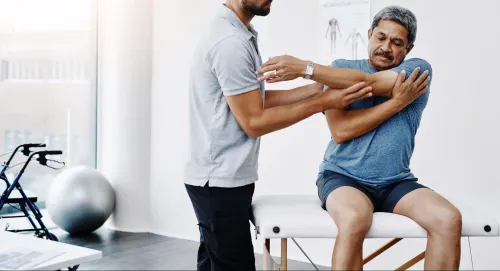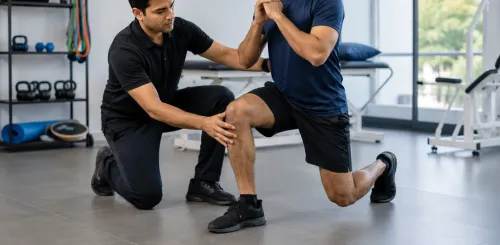
Returning to sport after an injury can be exciting, but feeling comfortable during everyday activities does not necessarily mean the body is ready for competition or full-intensity training. Effective sports rehabilitation should progressively prepare the athlete for the specific forces, speeds, and movements involved in the sport.
Before choosing a rehabilitation programme, it helps to know what meaningful sports recovery should involve.
A Clear Assessment of the Injury
Rehabilitation should start by understanding both the injury and the athlete.
The physiotherapist may assess movement, strength, mobility, balance, previous injuries, current symptoms, and sporting requirements.
A runner has different demands from a football player. A badminton player repeatedly accelerates, lunges, changes direction, and performs overhead movements.
These differences should influence rehabilitation.
Progressive Strength Development
Rest can sometimes be necessary during an early stage of injury management, but prolonged avoidance of physical loading may reduce strength and conditioning.
Rehabilitation should progressively rebuild the injured area's ability to tolerate force.
The programme may start with controlled exercises before introducing heavier resistance, faster movements, or more demanding functional tasks as appropriate.
Progression should be based on individual response rather than rushed simply because an event or competition is approaching.
Balance and Movement Control
Many sports require rapid reactions and control on one leg.
This makes balance and coordination particularly important after lower-limb injuries.
Rehabilitation may incorporate single-leg exercises, directional movements, landing control, and progressively more challenging balance tasks depending on the athlete's sport.
The purpose is to prepare for real movement demands rather than only performing exercises in predictable positions.
Sport-Specific Preparation
General strength is important, but sport has additional demands.
An athlete may eventually need to tolerate:
- Running
- Acceleration
- Deceleration
- Jumping
- Landing
- Cutting
- Direction changes
- Repeated high-intensity movements
- Sport-specific skills
Not every patient needs every activity. The programme should reflect the sport being resumed.
Objective Movement Assessment
Where clinically useful, movement analysis can provide additional information about how an athlete performs certain tasks.
For example, gait and movement assessment may help examine running or functional movement patterns alongside conventional strength and mobility testing.
At Curador Physiotherapy and Sports Rehabilitation Centre, rehabilitation can incorporate movement-focused assessment and progressive exercise according to the athlete's individual needs.
This may be particularly relevant to Pune's growing community of runners, gym enthusiasts, amateur athletes, and competitive sports participants.
A Planned Return to Training
Returning directly from rehabilitation to unrestricted sport can represent a large jump in physical demand.
A staged return is often more practical.
This might involve controlled drills, partial training, increasing training volume, and eventually full participation depending on the injury and individual progress.
Athletes should understand what they can currently do and what milestones remain.
Good sports rehabilitation is therefore not measured by how quickly someone gets back onto the field.
It should prepare the athlete for the demands waiting there.
A programme that combines assessment, progressive strengthening, movement control, sport-specific preparation, and clear return-to-activity planning provides a more structured pathway from injury towards participation.
Keywords